


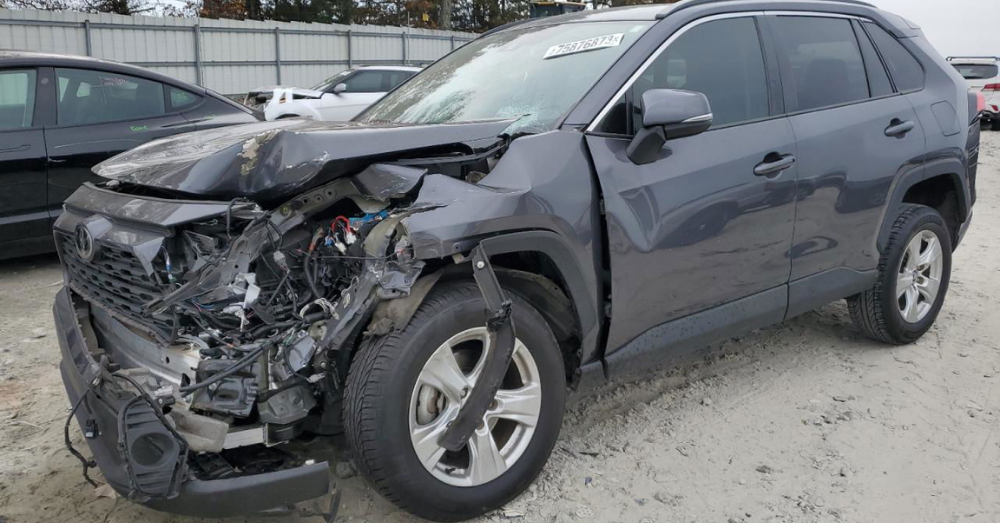
Picture this: you’re cruising down I-95 in Delaware when suddenly a Toyota RAV4 goes flying past you like something out of a Fast and Furious movie. The SUV launches off a guardrail, smacks into a light pole while airborne, does a complete flip, and somehow sticks the landing on all four wheels. The driver walks away. No, this isn’t fiction – it actually happened, and somebody’s dashcam caught every impossible second of it.
- A split-second panic decision near a guardrail turned a routine drive into an unplanned stunt that defied gravity
- Modern car safety tech proved its worth in the most bizarre circumstances, probably saving the driver’s life
- The whole thing got captured on a dashcam, creating footage so wild it looks fake
How to Turn Your Morning Commute Into a Physics Experiment
Let’s be real – we’ve all had those moments where we drift a little too close to something on the highway and have to make a quick correction. Most of us steer gently away and go on with our day. This driver in Wilmington decided to panic instead, and boy, did that decision pay off in the worst possible way.
Here’s how it went down: The driver of a dark red Toyota RAV4 got into a bit of a pickle last week on a freeway in Wilmington, Delaware, after seemingly getting caught off-guard. While we can’t tell you why this happened, it’s pretty obvious that the driver got spooked by getting too close to the left guardrail and didn’t act as they should. Instead of calmly steering his or her SUV away from the metal barrier, the driver kept applying the brakes until the vehicle ended up making contact with the divider, which in turn sent it skidding across all three lanes and into the opposite barrier.
But wait, there’s more. Instead of bouncing off the structure a second time, the Japanese SUV got launched upwards into a nearby light pole, before flipping over and spinning around. Eventually, it did land on all four wheels, but the damage was already done – you can even see the side airbags deployed on both the driver and passenger side.
When Guardrails Stop Being Your Friend
Guardrails are supposed to be the good guys. Traffic barriers (known in North America as guardrails or guard rails, in Britain as crash barriers, and in auto racing as Armco barriers) keep vehicles within their roadway and prevent them from colliding with dangerous obstacles such as boulders, sign supports, trees, bridge abutments, buildings, walls, and large storm drains, or from traversing steep (non-recoverable) slopes or entering deep water.
They’re basically highway bumper bowling – there to gently redirect you back where you belong. But sometimes they get creative and decide to launch you into orbit instead.
The problem is that guardrails have a dark history when it comes to unexpected outcomes. While this innovation prevented the rail from penetrating the vehicle, it could also vault a vehicle into the air or cause it to roll over, since the rising and twisting guardrail formed a ramp. These crashes often led to vehicles vaulting, rolling, or vaulting and rolling at high speed into the very objects that guardrails or barriers were supposed to protect them from in the first place.
The Delaware incident was a perfect example of this guardrail-turned-launch-ramp phenomenon. Hit it at just the wrong angle and speed, and congratulations – you’re now a test pilot.
Why This Driver Didn’t Become a Statistic
Here’s the thing that makes this story amazing rather than tragic: the driver walked away from what should have been a fatal crash. You can thank decades of engineers who figured out that making cars “weaker” actually makes them safer.
Modern cars use something called crumple zones. Crumple zones work by managing crash energy and increasing the time over which the deceleration of the occupants of the vehicle occurs, while also preventing intrusion into or deformation of the passenger cabin. This better protects car occupants against injury.
Think of it like this: If a car is travelling at 60 miles per hour, then everything within that car is travelling at 60 miles per hour. When you hit something and stop suddenly, your body wants to keep going at 60 mph. The car’s job is to slow you down gradually instead of letting you slam into the dashboard.
The sequence of speed-reducing technologies (crumple zones → seat belt → airbags → padded/deformable interior) is designed to work together as a system to reduce the peak force of the impact on the outside of the passenger’s body by lengthening the time over which the crash energy is transferred.
The visible airbag deployment in the footage shows this system working exactly as intended, even during a crash scenario that probably wasn’t in any engineering textbook.
The Camera Never Lies
Without dashcam footage, this would just be another “you’re not going to believe what happened to me” story that nobody would actually believe. These days, though, more people are installing dashboard cameras, and for good reason.
One driver shared their experience: I was involved in an accident where someone drove into the side of me. My insurance company was trying to tell me it was a 50/50 blame. Sent in the Dashcam footage, and they came back and said it was 100% the other party’s fault.
Modern dashcams are pretty sophisticated too. Designed to record continuously in 1080p, with the oldest files being automatically overwritten when the SD card is full. It can automatically preserve footage of the 12 seconds before and the 8 seconds following an abnormal shock while driving.
The Real Lesson Here
Look, we could talk about guardrail design flaws or the physics of projectile motion all day. But the real takeaway from this Delaware drama is simpler: don’t panic when things go sideways on the road.
The driver’s initial drift toward the guardrail wasn’t a big deal. Happens to everyone. The panic braking that followed? That’s what turned a minor course correction into an impromptu airshow.
Next time you find yourself getting a little too cozy with a guardrail, take a breath and steer gently away. Your goal is to keep all four wheels on the ground, not to test whether your SUV can fly.
And maybe invest in a dashcam. These days, you never know when your mundane Tuesday drive is going to turn into something that breaks the internet.
 Sarah Johnson